Blockading Venezuela, the US "hits hard" at Cuba

The United States continues to intercept Venezuelan oil tankers, which could seriously affect the economy of Cuba, a country in the region.
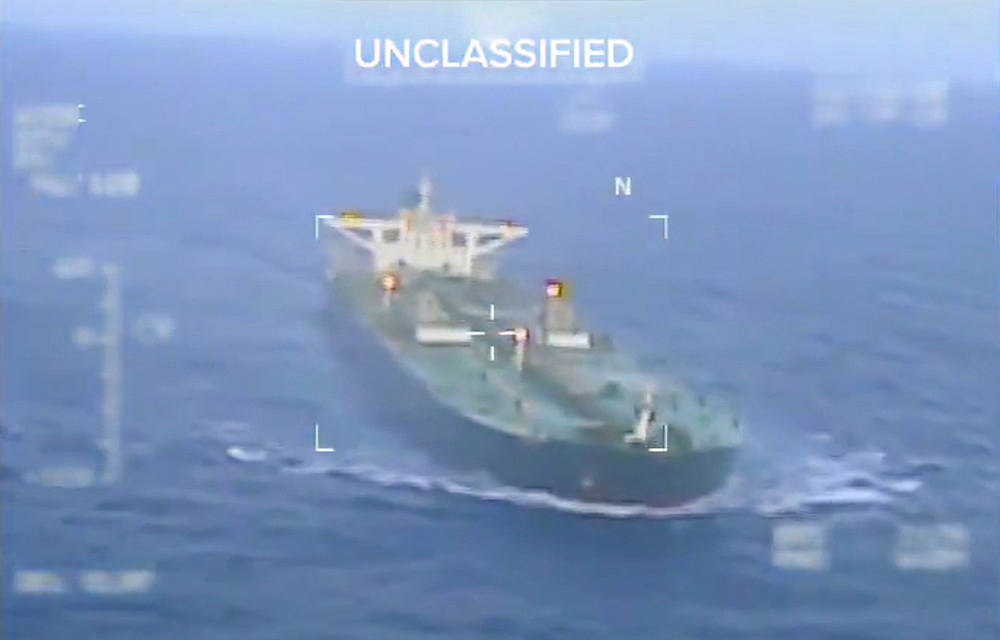
According to Xinhua News Agency, on the 21st, U.S. personnel intercepted an oil tanker near Venezuela in international waters and boarded it for inspection. The intercepted "Bella 1" tanker flies the Panamanian flag and is under U.S. sanctions. Early on the 21st, this tanker was boarded and inspected by U.S. personnel while en route to Venezuela to load cargo.
This is the third oil tanker intercepted by the United States in waters near Venezuela in recent days. On the 10th of this month, the United States first seized an oil tanker transporting oil to Cuba and announced the confiscation of the oil cargo. On the 16th, President Trump ordered a "comprehensive and thorough blockade" of all U.S.-sanctioned oil tankers entering or leaving Venezuela, and announced that the current Venezuelan government had been designated a "foreign terrorist organization."
Cuba is currently experiencing a severe economic crisis, with surging inflation and material shortages in recent years. Analysts point out that Cuba’s fuel mainly relies on Venezuela and other countries, and if Venezuelan crude oil imports continue to decline, Cuba’s economic situation may worsen.
Deep Energy Dependence between Venezuela and Cuba
According to The Wall Street Journal, since 1999, Venezuela has been crucial to Cuba’s economy. Then Venezuelan President Chávez described the two countries as “closely linked in an ocean of happiness.” Cuba sent sports coaches, doctors, and counterintelligence officers to Venezuela, while Venezuela responded by shipping 100,000 barrels of oil per day to Cuba.
However, as Venezuela’s oil production has plunged in recent years, it has reduced oil shipments to Cuba. For many years, Cuba has also reduced the number of doctors deployed in Venezuela.
Currently, oil shipments from Venezuela to Cuba have dropped to 30,000 barrels per day, and Venezuelan crude makes up about 40% of Cuba’s imported oil. This oil is crucial for power plants, transportation, and the small business sector. Cuba produces a small amount of oil locally and also receives some crude from Mexico and Russia.
Recently, Cuba has repeatedly and strongly opposed U.S. military expansion in the Caribbean, especially the seizure of oil tankers. The tanker seized by the U.S. on the 10th was transporting nearly two million barrels of Venezuelan oil to Cuba.
Cuban President Miguel Díaz-Canel recently stated: “Trump has just unleashed his pirates to attack a Venezuelan oil tanker, shamelessly looting cargo like a vulgar thief. The enemy’s rule is that there are no rules.”
Cuba’s deep dependence on Venezuela means the Cuban government will do everything it can to prevent Maduro from being forced out of power amid his dispute with the United States. When he was young, Maduro studied at a school in Havana, Cuba that trained leftist politicians.
“They take very good care of Maduro and his successors.” Former senior U.S. diplomat Thomas A. Shannon Jr., who frequently interacted with the Venezuelan government, said, “The Cubans will not quietly go into the night.”
Cuba’s Economy Faces Shock
If Venezuela’s oil shipments stop or drastically decrease, it will be devastating for Cuba. Jorge Piñón, who tracks Cuba-Venezuela energy ties at the University of Texas at Austin, told The Wall Street Journal, “Without a doubt, it would trigger the collapse of Cuba’s economy.”
According to a July Xinhua report, Cuba’s economic growth is currently difficult due to years of U.S. blockade and sanctions. With no access to development credit and insufficient foreign exchange income, Cuba suffers from shortages of raw materials, fuel, and equipment components.
Cuba is experiencing its worst economic crisis since the 1990s. Ricardo Torres Pérez, a Cuban economist at American University in Washington, noted that Cuba’s economy has shrunk by 15% since 2018, and cumulative inflation from 2018 to November this year was close to 450%. The Cuban peso has plummeted, with the black-market rate at about 1 U.S. dollar to 450 Cuban pesos, compared to about 1 to 30 in 2020.
Since 2020, a quarter of Cuba’s population—around 2.7 million people—have chosen to leave. “What Cuba is experiencing—the ‘hollowing out’ of the population—is nothing short of a humanitarian disaster equivalent only to that seen in countries in armed conflict,” said Ted Henken, a professor at Baruch College in New York who has written books on Cuba and frequently travels there.
This month, some legislators at Cuba’s National Assembly have frankly discussed the gravity of the situation. In a speech, Díaz-Canel said: “Cuba faces huge material shortages. We must assume the urgent need for macroeconomic stability. Without economic efficiency, sovereignty cannot be realized.”
Pérez pointed out that the decline in Venezuelan crude imports has created further shocks. “One could say the situation is already as bad as it can get, but we also know it will get worse. If these shipments continue to decrease in the next few weeks or months, the situation will become untenable.”
Source: The Paper
Risk DisclaimerThe market involves risk, and investment needs to be cautious. This article does not constitute individual investment advice, nor does it take into account specific investment objectives, financial situations, or needs of individual users. Users should consider whether any opinions, views, or conclusions in this article are suitable for their particular circumstances. Investment based on this is at your own risk.